Nurses pride themselves on their effective relationships with patients, including the ability to end the relationship professionally as appropriate (e.g., end of shift, completion of home therapy). However, if the nurse had a duty to care, and the patient experiences injury due to an inappropriate termination of the relationship, litigation may occur. The litigation may be in the form of civil lawsuits brought by patients or families, or even criminal prosecution. In addition, the nurse could face disciplinary action or loss of license through action taken by the state board of nursing.
Nurses need to understand what constitutes abandonment and take steps to avoid it to protect themselves against punitive legal and licensure actions.
What is patient abandonment?
The following criteria must be met to constitute patient abandonment:
- A nurse-patient relationship exists;
- The nurse terminates the relationship unilaterally without giving sufficient notice to the appropriate person so that other arrangements can be made;
- The patient still requires the nurse’s services. In addition, the patient doesn’t have enough time to find another alternative (or can’t, as in a hospital situation), or the nurse doesn’t arrange for someone else to care for the patient.
Bieber writes that the abandonment must result in “actual, measurable consequences” to the patient, such as higher medical bills or worse prognosis. This may be true in the case of legal action, but boards of nursing may take licensure action without this criterion.
The American Nurses Association (ANA) position statement on the rights of registered nurses when considering a patient assignment defines abandonment as:
“a unilateral severance of the established nurse-patient relationship without giving reasonable notice to the appropriate person so that arrangements can be made for the continuation of nursing care by others.”
Examples of patient abandonment include the following:
- Nurses who leave the facility after accepting an assignment (because they don’t feel staffing is effective) without notifying a supervisor and giving sufficient time for alternative arrangements;
- Nurses who leave the facility because they feel they don’t have the expertise to carry out the assignment (such as a traveler who is given an inappropriate assignment or a floater who is on a unit where they don’t feel they have the necessary skills) without notifying a supervisor and giving sufficient time for alternative arrangements;
- Nurses who fail to give adequate information when transferring care from one shift to another, from one unit to another, or from one setting to another at discharge;
- Nurses who fail to provide an expected home or hospice visit without notification;
- Nurses who sleep while on duty without supervisor approval;
- Nurse Practitioners (NPs) who terminate a relationship with a patient without making an effort to transfer care.
It’s important to note that a nurse-patient relationship also can exist when nurses volunteer their services outside of where they work. In addition, state laws vary in how patient abandonment is defined. For example, Brusie notes that if a hospital doesn’t provide enough staffing for the nurse to be able to provide adequate care, there may not be a case for patient abandonment.
Although not the focus of this article, it’s important to know that patient abandonment differs from employment abandonment, which refers to a nurse leaving an employment situation. For example, refusing an assignment may constitute employment abandonment but probably does not constitute patient abandonment because no nurse-patient relationship has been established.
The Oregon State Board of Nursing provides these examples of situations an employer may consider as employment abandonment but do not constitute patient abandonment:
- Nurses who fail to arrive for their agreed-upon assignment without notifying the employer;
- Nurses who resign without providing the amount of notice required by the employer;
- Nurses who end their employment immediately after patient duties have been completed;
- Nurses who fail to return to scheduled work hours after a leave of absence and fail to give notice.
The ANA patient assignment statement notes that: “Refusal to accept an assignment (or a nurse-patient relationship) does not constitute patient abandonment.”
Crucially, however, state laws and board of nursing regulations related to patient and employment abandonment vary.
Can care be stopped without abandonment?
In some situations, the nurse-patient relationship can be terminated without resulting in patient abandonment, if certain steps are taken:
- The patient dismisses the nurse, or the nurse and patient mutually agree to end the relationship;
- The patient repeatedly misses appointments;
- The patient doesn’t adhere to the care plan;
- The patient doesn’t comply with policies or acts inappropriately toward towards the nurse and/or other staff members;
- The nurse or NP doesn’t have the expertise or resources to care for the patient.
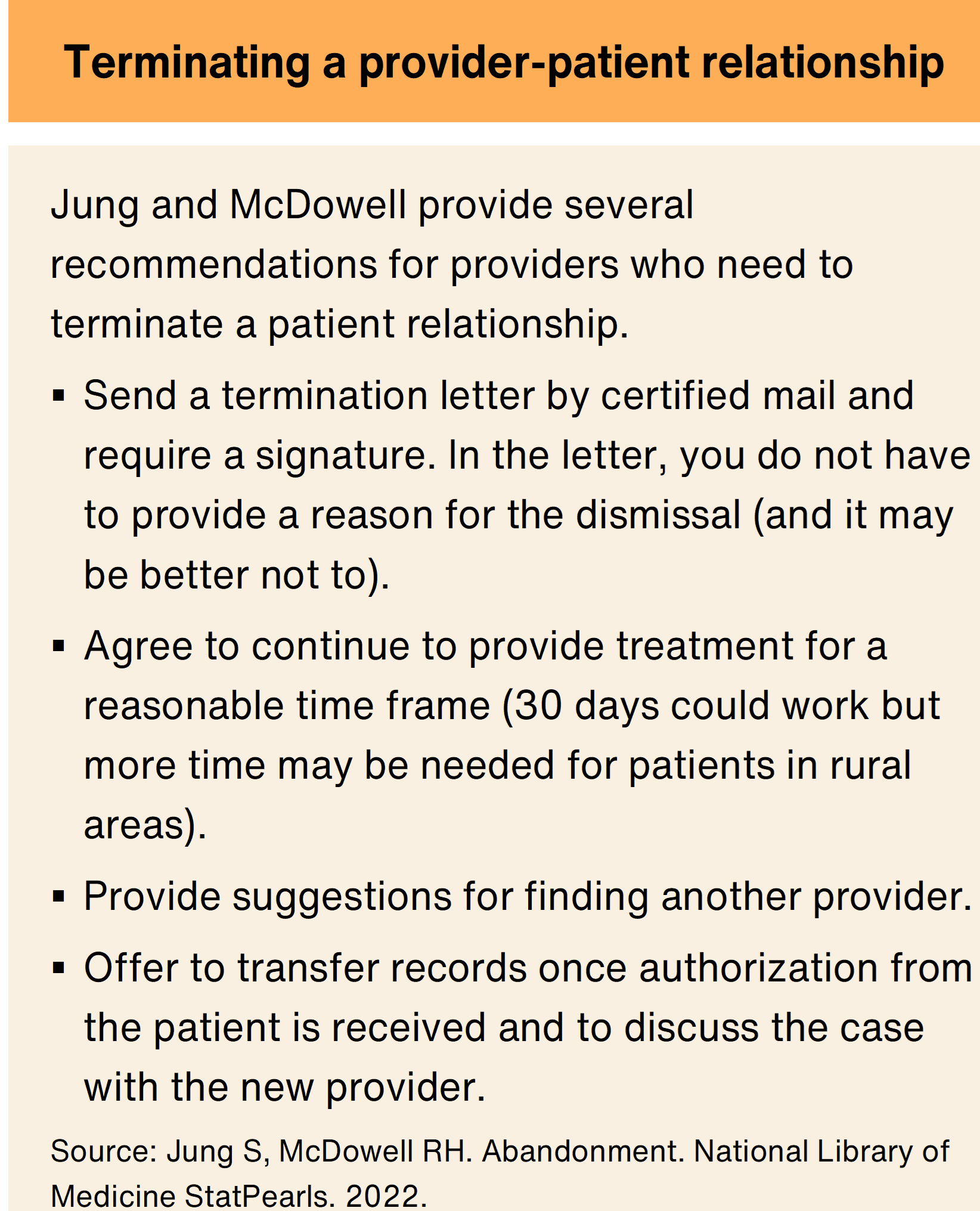
To avoid abandonment charges, the nurse or NP must first take all necessary steps per organizational policy and state and local regulations. This typically includes notifying the patient (verbal and written), giving the patient time to find another provider, and handing off the patient to the other provider (including sending records).
How can abandonment be avoided?
Nurses should consider several factors to avoid being charged with patient abandonment. First, timing is key. For example, an NP must give patient sufficient time to find another provider.
Second, know state laws and board of nursing position statements related to this topic.
Third, think before accepting a patient assignment because once the assignment is accepted, the nurse-patient relationship exists.
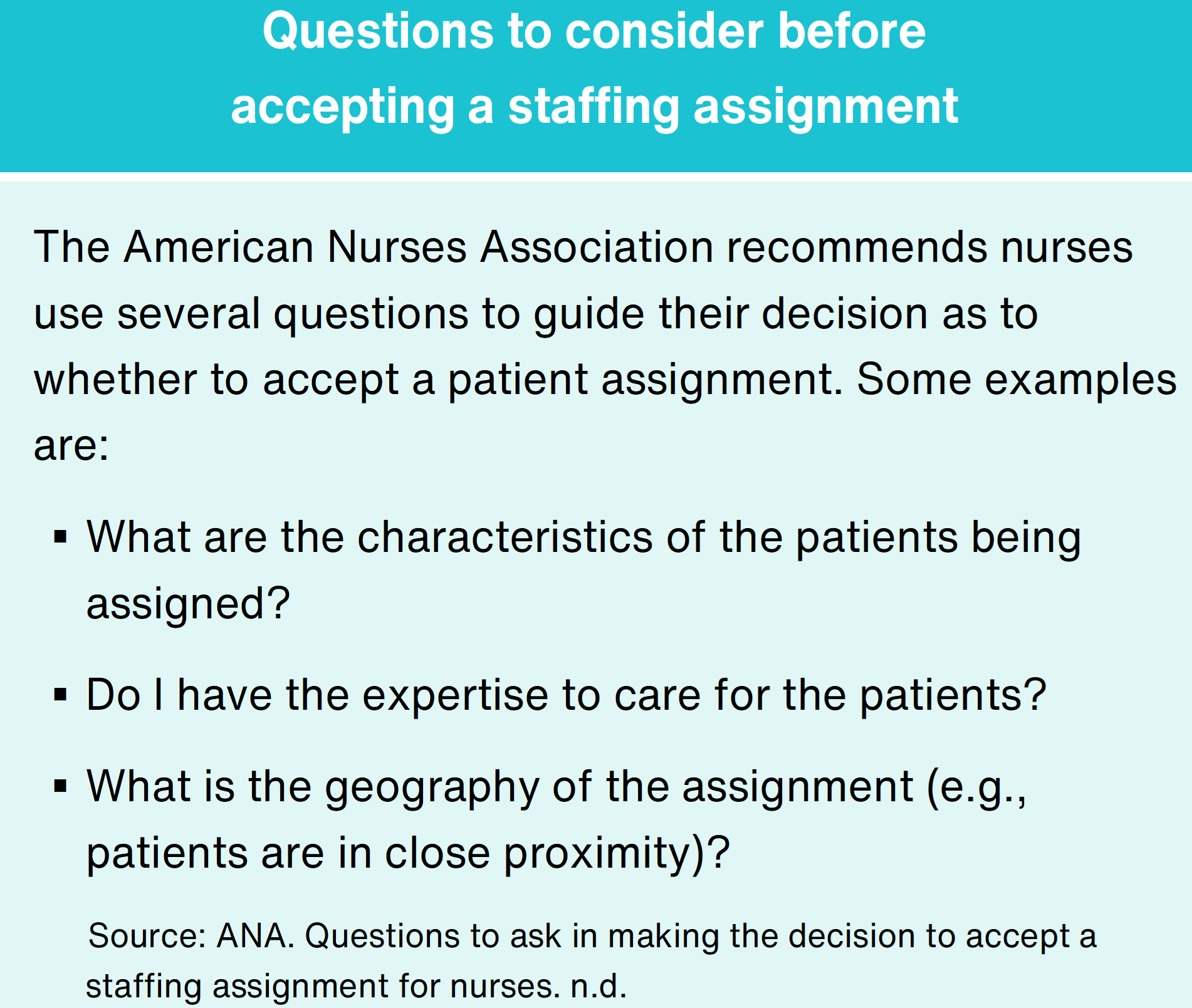
The ANA has questions to consider (see ‘
Questions to consider before accepting a staffing assignment’). If you are uncomfortable, see if the assignment can be modified. If you decide to refuse an assignment, give enough notice so alternative arrangements can be made.
Here are some additional suggestions, based on role, that will help avoid getting into a situation where the nurse probably should not have been assigned a patient, but now a nurse-patient relationship exists.
 Floating/traveling nurses.
 If you are a floating/traveling nurse:
- Ask that schedulers have access to a list of your skills;
- Speak up before you arrive for your assignment, but if you don’t hear back, show up and don’t leave until other arrangements have been made.
Staff nurses. If you are a staff nurse:
- Raise staffing concerns with management before being put in this situation. Document conversations and keep email communications;
- Suggest that those doing the scheduling have access to staff members’ competencies;
- If you arrive for your assignment and staffing is inadequate, notify the immediate supervisor. Do not leave the premises or encourage others to leave.
Nure Practitioners. NPs must be particularly cautious to avoid patient abandonment. Actions to take include the following:
- Document patient nonadherence;
- Communicate clearly and provide a written plan of care;
- Have formal policies and procedures in place;
- Notify patients verbally and in writing if you decide to terminate the relationship (see ‘Terminating a provider-patient relationship’).
Protecting patients and nurses
Nurses naturally want to deliver optimal patient care and not be accused of abandonment. By taking steps such as making arrangements when care needs to be transferred and allowing sufficient time for the transfer, nurses can protect themselves from litigation and licensure action and protect patients from gaps in care.
Lynn Pierce, FNP-C
Senior Risk Management Consultant with NSO
REFERENCES
Disclaimer: The information offered within this article reflects general principles only and does not constitute legal advice by Nurses Service Organization (NSO) or establish appropriate or acceptable standards of professional conduct. Readers should consult with an attorney if they have specific concerns. Neither Affinity Insurance Services, Inc. nor NSO assumes any liability for how this information is applied in practice or for the accuracy of this information. Please note that Internet hyperlinks cited herein are active as of the date of publication but may be subject to change or discontinuation.
This risk management information was provided by Nurses Service Organization (NSO), the nation's largest provider of nurses’ professional liability insurance coverage for over 550,000 nurses since 1976. The individual professional liability insurance policy administered through NSO is underwritten by American Casualty Company of Reading, Pennsylvania, a CNA company. Reproduction without permission of the publisher is prohibited. For questions, send an e-mail to
[email protected] or call
1-800-247-1500.
www.nso.com.
This publication is intended to inform Affinity Insurance Services, Inc., customers of potential liability in their practice. This information is provided for general informational purposes only and is not intended to provide individualized guidance. All descriptions, summaries or highlights of coverage are for general informational purposes only and do not amend, alter or modify the actual terms or conditions of any insurance policy. Coverage is governed only by the terms and conditions of the relevant policy. Any references to non-Aon, AIS, NSO, HPSO websites are provided solely for convenience, and Aon, AIS, NSO and HPSO disclaims any responsibility with respect to such websites. This information is not intended to offer legal advice or to establish appropriate or acceptable standards of professional conduct. Readers should consult with a lawyer if they have specific concerns. Neither Affinity Insurance Services, Inc., NSO, nor CNA assumes any liability for how this information is applied in practice or for the accuracy of this information.
Nurses Service Organization is a registered trade name of Affinity Insurance Services, Inc., a licensed producer in all states (TX 13695); (AR 100106022); in CA, MN, AIS Affinity Insurance Agency, Inc. (CA 0795465); in OK, AIS Affinity Insurance Services, Inc.; in CA, Aon Affinity Insurance Services, Inc., (CA 0G94493), Aon Direct Insurance Administrators and Berkely Insurance Agency and in NY, AIS Affinity Insurance Agency.